The Customers Leaving Without Telling You
Most cancellations can be prevented, and the last visit of the season is where a lot of them start
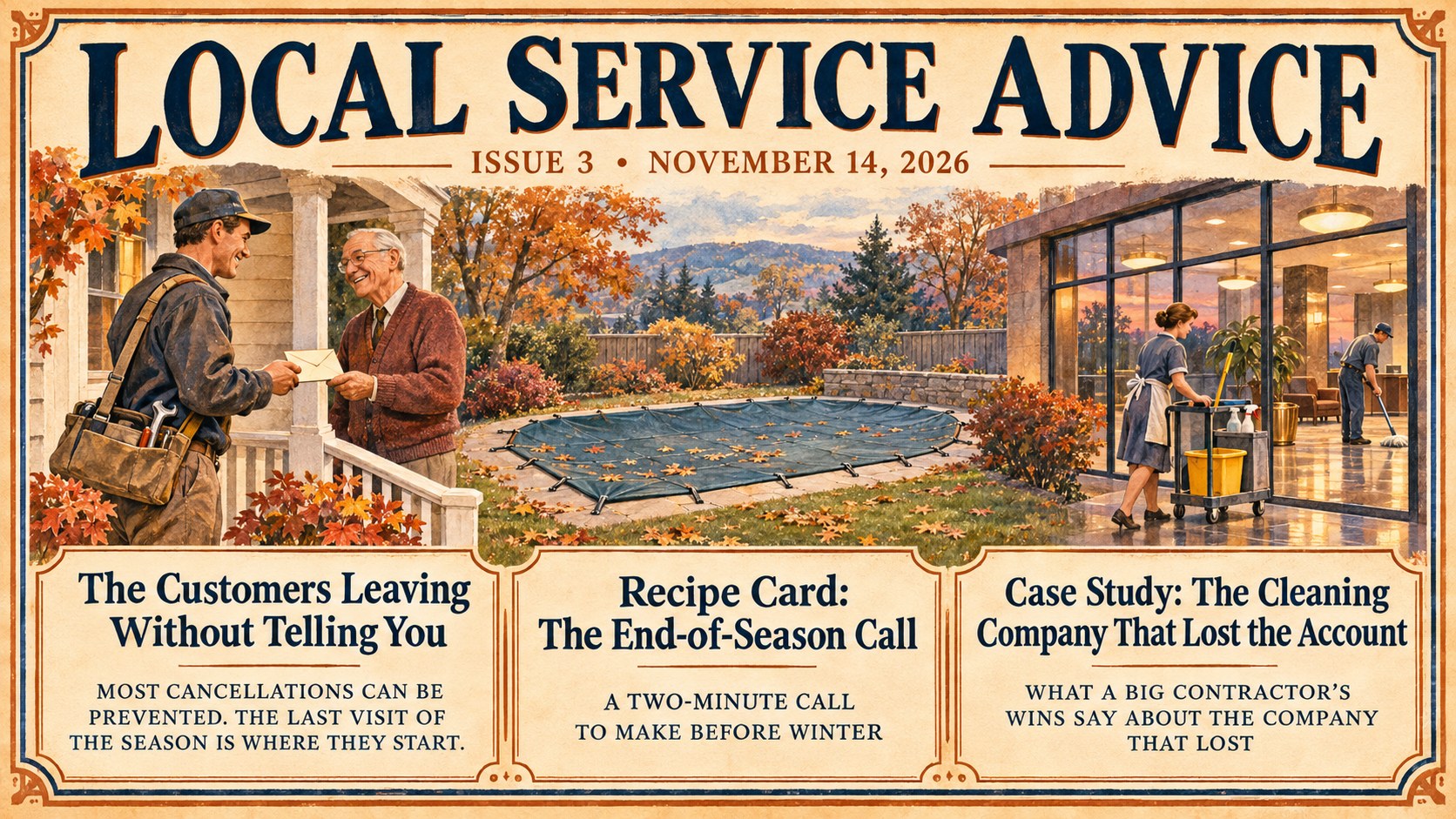
Here's Issue 3 of Local Service Advice. This one's about the customers who leave without saying a word, and the visit where it usually starts.
FYI: The partners in here sell tools that work for businesses like yours, at prices that make sense. I only suggest the ones that make a difference to your bottom line. If you buy through one of the links, they give me a cut. That's how this newsletter stays free. Forever.
Thanks and see you next week.
This week: why most cancellations are preventable, and what to do at the last visit of the season. Also, a two-minute call you can make before winter, and what a big cleaning contractor's case studies say about the company that lost the account.
The Customers Leaving Without Telling You
Nobody calls to say they're thinking about leaving. They just don't renew. The spring schedule comes out lighter than it should, and there's no complaint, no bad review, nothing to point at.
Kemp Anderson has spent his career in pest control. He started in branch operations at Sears Termite & Pest Control in 1995, built his own company and sold it to Terminix, and now advises owners who are getting ready to sell. In a talk Pest Control Technology covered in January 2020, he said 91% of service cancellations are within the company's control. His explanation for a lot of them was blunt: "A lot of times, they just don't think that we care about them anymore. We lose that personal touch."
He gave targets, too. A residential pest company should keep 82% to 87% of its customers each year. A commercial book should hold more than 94%. The same PCT piece puts the stakes another way: a two percent increase in retention does about as much for a business as a 10% cut in expenses.
Those are pest numbers, but pest isn't the only trade that loses customers this way. Jason Yamaguchi, founder of Cabana, a San Diego pool service company started in 2024, told the San Diego Business Journal that "the average pool company churns 40% of their customers every year." In commercial cleaning, the case study below shows what it looks like from the side that wins the account.
Why autumn matters
For a lot of you, the last visit of the year is happening now: the final lawn application, the pool closing, the last fall cleanup. Then nothing happens for three or four months.
That gap is where "they just don't think that we care" takes hold. The customer was happy enough with the service. But by March, the last thing they heard from you was an invoice, and the first thing they hear in spring might be someone else's door hanger.
Anderson's answer was simple: "Be in front of that customer interaction when you can." The PCT article names the biggest controllable threat as a lack of communication.
What staying in front of them looks like
None of this is complicated, and all of it can happen this month.
Say goodbye on purpose. Treat the last visit like a last visit. A note on the door or a word with the homeowner: thanks for the season, here's what I saw, here's when I'll be back. The call in the next section takes about two minutes.
Leave something behind. A thank-you at the end of the season lands differently than a coupon in the spring, because it doesn't ask for anything. Some owners use a small gift. That's where an incentive service like MarketingBoost fits: it lets you hand a good customer a restaurant voucher or a hotel-stay certificate for a flat membership fee, rather than paying for each one.
Show up once in the dead months. One piece of mail between the last visit and the first spring call. Not a sales letter. A card that says you're looking forward to next season, or a reminder of when you'll be back. More on how to do that at the end.
Ask the ones who already left. Pull last year's customer list and mark everyone who didn't come back this year. Call five of them. Don't sell anything; ask what happened. If Anderson is right, most of the answers will be things you could have fixed.
The math on one customer
Take a residential customer who pays $600 a year and would have stayed five years. That's $3,000 leaving without a phone call. If the call, the card and the gift cost you $10 a customer and keep one in twenty who would otherwise have drifted off, you're spending $200 to keep $3,000.
The customers leaving without telling you aren't unhappy enough to complain. They just haven't heard from you in a while.

The week after the last visit is the easiest time to call a customer, because you have a reason to. Here's a two-minute version. Make it yourself, or have whoever answers your phone make it.
"Hi [Name], it's [your name] from [Company]. We just did your last [service] of the season, and I wanted to say thanks for this year.
While I've got you: was there anything this season you'd have liked us to do differently?
[Listen. Write it down.]
Great. We'll be back around [month], and I'll send a reminder before then. Have a good winter."
Three things make it work. Don't pitch anything; a renewal offer can go in the mail later. Write down what they say, in their words, in the customer file, so the first spring visit can start with "you mentioned." And if they raise a problem, fix it before winter, not after.
If you have 300 customers, you won't call them all. Start with two groups: the ones who have been with you longest, and the ones who had a callback or a complaint this year. Those are the two you can least afford to lose quietly.
Case Study: The Cleaning Company That Lost the Account
Harvard Maintenance is a commercial cleaning contractor with more than 60 years in the business, working across the lower 48 states. It's a lot bigger than most of you. But its website publishes case studies, and several of them start the same way: with the other cleaning company.
In the fall of 2024, Harvard took over the cleaning at a new mixed-use development in Nashville, with Class AA offices, condominiums, a luxury hotel and shops. According to Harvard's write-up, tenants had complained that "cleaning tasks were missed, communication was poor, and accountability was lacking." Several attempts to fix it didn't work. Much of the night cleaning had been subcontracted without the client knowing.
Harvard says its price may not have been as low as the incumbent's. It won the work anyway. Before the award, it walked the building with the property manager. Afterward, it walked the tenants' suites one by one, wrote down what each tenant needed in a building playbook, and held weekly meetings with the client. It also put a dedicated supervisor on the night shift; the old setup had 20 hours a week of account management.
Another Harvard case study covers a 1.2 million square foot corporate campus. The client came to Harvard in 2016 "due to quality concerns with the previous cleaning program," and it's still a client nearly ten years later.
Now read both from the other side. Tenants complained to the property manager. The property manager tried to get it fixed, more than once. Then the work went to someone else. None of that shows up as a cancellation until the day it is one.
The part a smaller crew can copy is the walkthrough. Harvard didn't win Nashville on price. It won by asking tenants, one suite at a time, what they needed, and writing it down. You can do that with every account you have, before somebody else does it for you.
This week's featured partner: Thanks.io
The card in the dead months is the step most owners skip, because it's a chore: buy the cards, write them, address them, stamp them, mail them.
Thanks.io does that part for you. You upload your customer list and write the message once. It prints each card in a handwriting-style font, addresses it, adds postage and mails it. It also connects to other software, so a card can go out automatically when a job closes.
There's a pay-as-you-go plan with no monthly fee. On that plan, a 4x6 postcard runs a little over a dollar, postage included. Paid plans start at $49 a month and bring the price per card down, which matters once you're mailing your whole list.
Here's to one more client this week.
R.J.
Ask R.J. Have a question about getting or keeping customers? Email me at [email protected]. I'm collecting questions for a future advice column.
References
- Pest Control Technology, coverage of Kemp Anderson's retention talk at the PCT M&A Virtual Conference (January 2020 issue). pctonline.com
- Pest Control Technology, "Kemp Anderson," profile. pctonline.com
- San Diego Business Journal, profile of Cabana and founder Jason Yamaguchi. sdbj.com
- Harvard Maintenance, "Case Study: Seamless Transition and Strategic Labor Planning at Premier Class AA Mixed-Use Space," June 26, 2025. harvardmaint.com
- Harvard Maintenance, "Optimizing Cleaning Scope and Reducing Costs for an Innovative Global Imaging Solutions Leader," May 13, 2026. harvardmaint.com
- Harvard Maintenance, company pages ("over 60 years," service area). harvardmaint.com
- Marco Torres, founder of MarketingBoost, interview on Unbound with Chris DuBois. transistor.fm
- Thanks.io, "How Much Does Thanks.io Cost?" thanks.io
- Thanks.io, US pricing table (pay as you go, Business and Professional rates). thanks.io
Want more like this every week?
One email, every Tuesday at 6 AM. Strategies, case studies, and tools for growing your local service business.