The Discount Trap
What a Black Friday discount really costs a service business, and what to offer instead
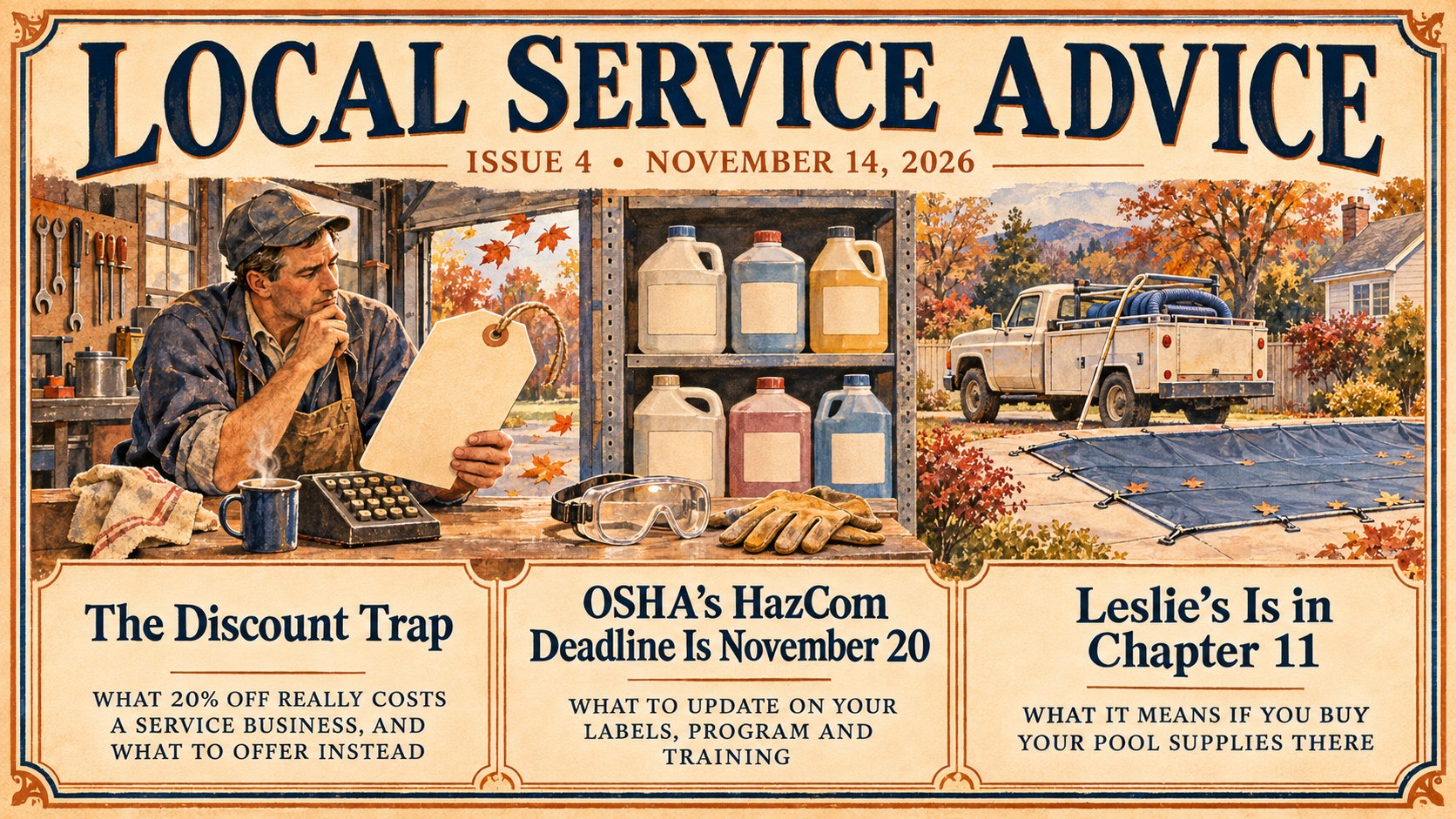
Here's Issue 4 of Local Service Advice. This one's about Black Friday, and why the discount you're tempted to run costs more than it looks.
FYI: The partners in here sell tools that work for businesses like yours, at prices that make sense. I only suggest the ones that make a difference to your bottom line. If you buy through one of the links, they give me a cut. That's how this newsletter stays free. Forever.
Thanks and see you next week.
This week: what a holiday discount really costs a service business, and what to offer instead. Also, an OSHA deadline on November 20, and what the Leslie's bankruptcy means if you buy pool supplies there.
The Discount Trap
Black Friday is November 27 this year. Between now and then your inbox will fill up with 20% off, 30% off, half off. Some of it will come from other service companies, and it's tempting to match it: 20% off next season if you book by Friday.
Before you do, run the numbers on one job.
What 20% off really costs
Say a job sells for $200 and costs you $120 in labor, product and fuel. That's $80 of gross profit. Take 20% off and the price drops to $160. Your costs didn't move, so your profit is now $40.
You cut the price by a fifth and your profit in half. To make the same $80, you need two discounted jobs for every full-price job you were doing before.
The thinner your margin, the worse it gets. If that same $200 job costs you $140, you make $60 at full price and $20 at 20% off. Now you need three jobs to replace one.
Here's the quick check for your own numbers: divide your margin by your margin minus the discount. A 40% margin with 20% off is 40 divided by 20, so two jobs for every one. A 30% margin with 20% off is 30 divided by 10, so three.
The customers a discount brings in
The bigger cost shows up later. In 2006, the Journal of Marketing Research published a study by Michael Lewis that looked at customer records from a newspaper and an online grocer. The deeper the discount used to bring a customer in, the less often that customer bought again. A 35% sign-up discount produced customers worth about half as much over the long run as customers who came in at full price.
Those weren't service businesses, and your numbers will be different. But the pattern is worth taking seriously. A customer who came for the price has already told you what they came for.
What to offer instead
The point of a holiday offer is to give someone a reason to say yes now. Price is one reason. It isn't the only one.
Add something instead of taking something off. A bonus service costs you what it costs you, not what you charge for it. If an add-on sells for $150 and costs you $50 to do, throwing it in costs $50. Taking $150 off the bill costs $150.
Reward the customers who already pay full price. Your best customers rarely see your discounts, because discounts are aimed at people who haven't bought yet. A loyalty card flips that. Loopy Loyalty puts a digital stamp card in your customer's Apple Wallet or Google Wallet: every fifth visit, something on the house. It starts at $25 a month, with a free trial.
Give a reward with a high perceived value and a fixed cost. This is what MarketingBoost is built for, and there's more on it at the end of this issue.
Use a deadline, not a discount. In Issue 2, Chris Noon's second prepay offer was simple: prepay and skip next year's price increase. The customer gets a reason to act now, and this year's price stays where it is.
You don't have to sit Black Friday out. Just make sure the offer you send still leaves you a business in March.

OSHA rewrote its Hazard Communication Standard in 2024, and in January it pushed the deadlines back four months. The first one for employers lands on Friday, November 20.
By that date, for single-chemical products (OSHA calls them substances), employers have to update their workplace labels, their written hazard communication program and their employee training where the new rules changed something. Blended products, which OSHA calls mixtures, get until May 19, 2028. Until each date, you can follow either the old version of the standard or the new one.
This isn't a paperwork rule that nobody enforces. Hazard communication was OSHA's second most-cited standard in the preliminary numbers for fiscal year 2026, with 1,961 citations.
If your crew handles pool chemicals, pesticides, cleaning concentrates or treatment products, here's the short version:
- Check the safety data sheets that came in from your suppliers this year. Manufacturers had to update theirs for substances by May 19.
- Where a hazard changed, update the labels on anything you transfer into your own containers, like spray bottles, and update your written program.
- Train your crew on what changed, and keep a log with the date and who attended.
Leslie's Is in Chapter 11. Here's What It Means If You Buy There.
On September 30, Leslie's filed for Chapter 11 in federal bankruptcy court in Texas. It's the largest pool and spa supply retailer in the country, founded in 1963, and it sells to homeowners and pool pros alike.
The filing is prearranged with its lenders. The plan cuts about $685 million of debt, roughly 90% of its funded debt, and hands majority ownership to that group of lenders. Leslie's expects to come out of Chapter 11 in early 2027. In the filing, it listed $1.2 billion in debt against $722 million in assets.
It's also closing 76 of its more than 900 stores. It hasn't said which ones. The rest stay open, and the company says gift cards and loyalty benefits will still be honored.
Three things worth taking from it.
Check your store before spring. Fewer than one store in ten is closing, so yours is probably fine. But if you count on a Leslie's for chemicals or parts, ask the manager now, not the week of your first openings. And if you don't already have an account at a second supply house, this is a good winter to open one.
Weather hits the biggest players too. Leslie's has blamed the weather: it said bad weather meant fewer pool problems, and fewer pool problems meant fewer sales of its higher-margin specialty chemicals. That's the quiet-months lesson from Issue 2 at the scale of 900 stores: revenue that only shows up when the weather cooperates is hard to plan around.
Watch the DIY customers. If a Leslie's near you closes, the homeowners who bought their own chemicals there will need a new routine. Some of them will decide it's easier to pay someone. A door hanger in that neighborhood next spring wouldn't be wasted.
This week's featured partner: MarketingBoost
If you want a holiday offer that isn't a discount, this is the tool I'd look at.
MarketingBoost gives you hotel-stay certificates, from three to seven nights at destinations around the world, plus restaurant vouchers, to hand out as rewards, bonuses or raffle prizes. You pay a flat membership, not a fee per certificate, so giving away ten costs you the same as giving away one.
Be upfront with your customers about one thing: the certificate covers the room, and the person who uses it pays the hotel's taxes and any resort fees. Say so when you hand it over, and it's a gift. Leave it out, and it's a surprise nobody wants.
Here's what it looks like as a Black Friday offer: book next season by December 1 at full price, and get a three-night hotel stay certificate. The customer gets something that feels bigger than 20% off. You keep your price.
Here's to one more client this week.
R.J.
Ask R.J. Have a question about getting or keeping customers? Email me at [email protected]. I'm collecting questions for a future advice column.
References
- Michael Lewis, "Customer Acquisition Promotions and Customer Asset Value," Journal of Marketing Research, Vol. 43, No. 2, May 2006, pp. 195 to 203. doi.org
- Loopy Loyalty pricing, Capterra listing. capterra.com
- Christopher Noon, "Motivating customers to prepay," Landscape Management, January 9, 2015. landscapemanagement.net
- Occupational Safety and Health Administration, final rule extending the Hazard Communication Standard compliance dates, January 2026. federalregister.gov
- Safety+Health, "OSHA gives more time to comply with HazCom changes." safetyandhealthmagazine.com
- Occupational Safety and Health Administration, "Top 10 Most Frequently Cited Standards," fiscal year 2026 (preliminary). osha.gov
- KTAR News, "Phoenix pool retailer Leslie's files bankruptcy papers, strikes deal to cut 90% of debt," September 30, 2026. ktar.com
- Bisnow, "Pool Supplier Leslie's Files For Bankruptcy, To Close 76 Stores." bisnow.com
- Chain Store Age, "Pool supplies retailer Leslie's files for bankruptcy; closing some stores." chainstoreage.com
- KTVU FOX 2, "Pool supplies retailer files for bankruptcy, to close 76 stores," October 5, 2026. ktvu.com
- AZFamily, "Phoenix pool supplies retailer Leslie's files for bankruptcy, closing 76 stores," September 30, 2026. azfamily.com
- Marco Torres, founder of MarketingBoost, interview on Unbound with Chris DuBois. transistor.fm
- "Marketing Boost Review," a member's guide to how the certificates work, including taxes and resort fees. sites.google.com
Want more like this every week?
One email, every Tuesday at 6 AM. Strategies, case studies, and tools for growing your local service business.